

By Sid Peddinti, Esq.
Family Office Architect • Tax Attorney • Nonprofit Advisor
Dear Athlete,
Your career may be short.
Your name, IP, wealth, and legacy don’t have to be.
Whether you’re entering NIL, signing a major contract, playing professionally, or planning life after sports, the real risk is often not one bad decision.
It’s disconnected advice.
Your agent handles deals.
Your CPA handles taxes.
Your lawyer handles documents.
Your advisor handles investments.
But who connects the dots?
NIL. IP. Taxes. Trusts. Businesses. Investments. Foundations. Family. Legacy.
That’s where we come in.
We use family office architecture, forensic research, and Hybrid AI to identify gaps, protect what you build, reduce unnecessary leakage, and create long-term opportunities on and off the field.
This guide answers 101 questions every athlete and family should be asking.
The Athlete’s Guide To Maximizing Time, Talent, and Treasure Off The Pitch
Connecting The Dots: Business • Estate • Nonprofit • Tax • IP & NIL

PART I: NIL & INTELLECTUAL PROPERTY FOUNDATIONS – Questions 1- 15
PART I: NIL & INTELLECTUAL PROPERTY FOUNDATIONS
1. “What is the real legal difference between my Right of Publicity and a registered Trademark?”
That’s a fundamental question—and confusing them leaves your brand wide open to theft. Your Right of Publicity is a state-level doctrine that lets you stop unauthorized commercial use of your personal identity (face, voice, name). However, it does not give you exclusive nationwide commercial ownership of a brand name or product line. Only a federally registered Trademark with the USPTO under the Lanham Act (15 U.S.C. § 1051) gives you that exclusive monopoly across specific commercial classes (e.g., Class 25 for apparel, Class 35 for retail services).
- Right of Publicity: State-level protection covering your face, name, and voice against unauthorized commercial theft.
- Trademark Registration: Federal legal ownership of specific logos, catchphrases, and brand names nationwide.
- The Bottom Line: Without registered trademarks, squatters can register your catchphrase and legally block you from printing your own gear.
2. “At what exact second does my personal brand IP become legally enforceable?”
Intellectual property isn’t created when you post a story on Instagram; it becomes legally enforceable the exact second it is affixed to a tangible medium or used in interstate commerce. You must document exact timestamps, design files, and first-use dates to establish legal priority.
- First-Use Priority: The first party to legally use a mark in interstate commerce holds priority rights over later filers.
- Intent-To-Use (ITU): High school and college stars should file ITU federal applications to lock up nationwide priority before launching merchandise.
- Digital Timestamping: Maintain archived, timestamped design files to prove original creation during IP ownership disputes.
3. “How do corporate brands steal an athlete’s celebratory move or catchphrase without paying?”
If a signature celebration move or post-game catchphrase goes viral and you haven’t filed intent-to-use federal trademark applications, corporate giants and video game developers will monetize that cultural moment across apparel and digital media without paying you a single cent.
- Unprotected Culture: Cultural moments without federal IP registration are legally exploited by third parties for free.
- Apparel Class Filings: Lock up Class 25 (Apparel) and Class 35 (Online Retail) immediately when a moment goes viral.
- Cease-and-Desist Power: A registered trademark gives you the legal power to issue immediate takedowns and demand lost royalty profits.
4. “What happens to my IP when I sign an ‘exclusive’ endorsement deal with a major sponsor?”
When you sign an “exclusive” agreement, you often surrender the right to use your own persona with competing products or even your own personal business lines. If your attorney doesn’t draft strict category carve-outs, your primary revenue engine becomes legally locked down.
- Category Traps: Don’t let a sponsor claim broad “athletic apparel” if they only manufacture performance footwear.
- Personal Business Carve-Outs: Retain explicit rights to launch personal lifestyle, nutrition, or charitable brand lines.
- Competitor Definitions: Demand an explicit list of prohibited competitor companies attached directly to the contract exhibits.
5. “Why should I rent my IP through licensing agreements instead of selling it outright?”
The most dangerous term in a sponsorship deal is an outright “assignment of rights.” You must structure every deal as a strict, limited, non-exclusive or exclusive License Agreement. Sponsors should only rent temporary access to your image; you must retain 100% underlying ownership inside your Holding LLC.
- Licensing vs. Assignment: Licensing rents usage rights for a defined term; assignment sells your IP forever.
- Defined Parameters: Limit licenses by geography, specific media channels, and explicit duration limits.
- Reversionary Rights: Ensure all commercial rights automatically revert to your Holding LLC upon contract expiration.
6. “What is a semi-annual IP Audit and why is it mandatory for high-earning athletes?”
Every six months, our firm audits an athlete’s digital and physical brand footprint. We track who is using your likeness, identify expired licensing deals that are still illegally printing gear, and catch bootleggers profiting off your name.
- AI Automation: Develop and depoly AI tools and agents to conduct daily scans that track your NIL and IP rights across various platforms.
- Rights Tracking: Audit expired sponsor contracts to ensure former partners stopped using your image.
- Bootleg Takedowns: Issue automated cease-and-desist notices to unauthorized online retail shops.
- Damage Recovery: Recover unpaid licensing fees and statutory damages from unauthorized commercial users.
7. “How do I protect my digital avatar and AI likeness from unauthorized commercial cloning?”
Generative AI and 3D scanning allow studios to synthesize your face, voice, and athletic movements. Under 15 U.S.C. § 1125(a) (false endorsement claims), contracts must mandate explicit opt-ins, separate digital licensing fees, and full ownership reservations over wearable biometric data.
- AI Reservation Clauses: Explicitly reserve all AI, synthetic media, and digital cloning rights in every contract.
- Voice Copyrights: File formal copyright registrations on high-fidelity digital audio recordings of your voice.
- Separate Digital Fees: Charge separate, recurring licensing fees if a sponsor wants to utilize a synthetic AI avatar.
8. “Can a university fine or suspend me for using my personal logo on campus grounds?”
Yes—if your personal logo incorporates university color schemes, stadium contours, or trademarked school iconography without an explicit institutional license.
- Institutional Marks: School logos, mascot names, and specific color combinations are university-owned IP.
- Dual Licensing Models: Execute clear co-branding agreements that divide institutional marks from your personal logo.
- Clean Logo Separation: Maintain a primary personal logo that operates completely independent of school branding.
9. “What does the phrase ‘in perpetuity throughout the universe’ actually mean in a contract?”
If a contract includes “in perpetuity throughout the universe,” you are surrendering your image rights forever. I’ve reviewed deals signed by young recruits giving video game companies rights to use their college image for life for a small one-time fee of $2,500. Avoid this tempation.
- Lifetime Surrender: Eliminates your ability to monetize that specific era of your career down the road.
- Mandatory Term Sunset: Cap all image usage terms to defined windows (e.g., 1–2 years max).
- Buy-Out Multipliers: Force companies to pay substantial annual buy-out fees to extend image rights beyond term expiration.
10. “How do high school phenoms lock up their IP before stepping onto a college campus?”
High school recruits are most vulnerable before entering college. Establishing state-level entity filings, federal trademark filings, and copyright registrations before stepping onto campus establishes pre-existing business structures that insulate recruits from aggressive school policies and predatory early advisors.
- Pre-Existing Entities: Form holding companies prior to enrollment to establish separate corporate existence.
- Prior IP Proof: Document that personal logos were created independently prior to university enrollment.
- Eligibility Protection: Ensure early high school deals strictly comply with state high school athletic association rules.
11. “How do I reclaim domain names and social handles held hostage by squatters?”
When a squatter holds your domain name or verified social handles hostage, filing a Uniform Domain-Name Dispute-Resolution Policy (UDRP) arbitration complaint or issuing trademark cease-and-desist orders is the fastest route to reclamation. Stop trying to negotiate cash payouts with internet squatters; use federal trademark priority to take what is yours.
- UDRP Complaints: Reclaim .com domains held by squatters in bad faith using registered trademark priority.
- Platform Seizures: Submit trademark registration certificates directly to social networks to seize handles.
- Zero Ransom Payments: Never pay cash ransoms to bad-faith squatters; it establishes bad legal precedent.
12. “How do I navigate co-branding agreements with my university without losing my brand identity?”
Navigating NIL co-branding agreements with universities requires a bifurcated revenue agreement: one contract for the institutional intellectual property and an independent contract for the athlete’s individual persona. Merging these two into a single contract exposes the athlete to institutional control over their independent brand value.
- Bifurcated Contracts: Keep university IP royalty terms separate from your personal endorsement compensation.
- Independent Ownership: Ensure the co-branded product line automatically expires when you graduate or transfer.
- Royalty Audits: Verify that the school isn’t deducting institutional administrative fees from your personal payout.
13. “What is the legal difference between video game group licensing and surrendering my individual rights?”
Participating in collective video game licensing structures must not waive your rights to negotiate individual cover-athlete deals, custom digital avatar endorsements, or spin-off game appearances.
- Group Carve-Outs: Ensure group licensing participation explicitly excludes individual promotional campaigns.
- Roster vs. Cover: Separate default roster inclusion payouts from premium cover-athlete marketing rights.
- Digital Asset Expiration: Cap game developers’ rights to use your digital avatar strictly to the specific annual title release.
14. “How can non-revenue and niche sport athletes package their IP to command corporate dollars?”
Athletes in non-revenue sports (track, gymnastics, swimming) often possess exceptionally high engagement across digital channels. Package your digital IP, behind-the-scenes content access, and personal storytelling into specialized corporate sponsorship packages rather than relying on traditional broadcast visibility.
- Niche Engagement: Leverage highly dedicated digital audiences to command premium sponsor rates.
- Direct-To-Consumer: Build owned subscription communities bypassing traditional sports media gatekeepers.
- Global Storytelling: Target international corporate brands interested in Olympic and global sport exposure.
15. “How do I monetize custom workout programs and performance systems legally?”
Your custom training regimens, nutritional protocols, and performance strategies are valuable intellectual property. Package these trade secrets into digital subscriptions, proprietary apps, or licensed training systems protected by strict non-disclosure terms and copyright registrations.
- Trade Secret Protection: Protect proprietary training metrics behind secure digital paywalls.
- App Licensing: License training systems to fitness platforms in exchange for equity and royalties.
- Copyrighted Media: File formal copyrights on training manuals, video courses, and digital guides.

PART II: TAX ARCHITECTURE & THE MATH OF MISMANAGEMENT – Questions 16 – 30
PART II: TAX ARCHITECTURE & THE MATH OF MISMANAGEMENT
16. “Where does a $10 Million headline contract actually go?”
Athletes celebrate headline contract numbers while ignoring tax reality. On a $10,000,000 contract, top-bracket federal taxes, state taxes, jock taxes, agent fees, and union dues slice off over $5.5 Million before you buy a single meal.
- Gross Salary: $10,000,000 headline contract value.
- Federal Income Tax (37% Top Bracket): -$3,700,000.
- Agent & Union Fees (3%–4% Avg.): -$400,000.
- State, Local & Jock Taxes: -$1,000,000 to -$1,300,000 (Multi-state duty day allocations).
- Net Cash Left: ~$4,600,000 to $4,900,000—before living expenses, mortgages, or supporting family.
17. “How does the multi-state ‘Jock Tax’ track my athletic earnings?”
Non-resident athletes are taxed in nearly every state where they play games based on duty days worked in that jurisdiction over total work days in the calendar year.
- Duty Day Allocations: Salary is taxed based on days spent working in each visiting state.
- Double Taxation Risks: Bad CPA filings lead to paying state taxes twice on the same dollar earned.
- Local City Taxes: Cities like Philadelphia, Detroit, and New York impose local non-resident taxes.
18. “What is the legal difference between tax avoidance and tax evasion?”
Strategic tax avoidance uses statutory tax codes, legal write-offs, S-Corp elections, and trust structures to minimize taxes. Tax evasion is hiding offshore cash, faking business expenses, or failing to report NIL perks—and it will land you in federal prison.
- Tax Avoidance: Structuring income via S-Corps, DAFs, and legal deductions (100% Legal).
- Tax Evasion: Hiding cash payments, false expense logs, failure to file returns (Federal Crime).
- Expert Counsel: Never let uncredentialed advisors push you from legal strategy into tax fraud.
19. “Why should I elect S-Corporation tax status for my NIL LLC?”
Operating as a standard single-member LLC exposes every dollar of net income to a 15.3% Self-Employment tax (Medicare + Social Security). Electing S-Corporation tax status under IRC Sec. 1362 allows you to split income between a reasonable W-2 salary and owner distributions, saving tens of thousands annually.
- Self-Employment Tax: Cuts 15.3% off default single-member LLC net earnings.
- S-Corp Split: Pay self-employment tax only on the reasonable W-2 salary portion.
- Distribution Savings: Net profit distributions bypass self-employment taxes completely.
20. “Are free luxury cars, designer clothes, and crypto gifts considered taxable income?”
Yes. Under IRC Sec. 61, the IRS does not care if a brand paid you in cash or product. Every single non-monetary perk is classified as taxable gross income at Fair Market Value (FMV). Free $50,000 gear equals owing real cash taxes on $50,000.
- Fair Market Value: Free items are taxed based on retail value at time of receipt.
- Form 1099 Discrepancies: Brands issue 1099s for free perks; omitting them triggers automated audits.
- Cash Tax Reserves: You need liquid cash reserves to pay taxes on non-cash sponsor gifts.
21. “How do I avoid quarterly IRS interest penalties on 1099 NIL money?”
1099 independent contractor money has zero tax withheld at receipt. If you earn endorsement income and fail to pay quarterly estimated taxes to the IRS, you face mandatory underpayment interest penalties.
- Quarterly Deadlines: April 15, June 15, September 15, and January 15.
- Safe Harbor Rules: Pay 110% of prior year tax liability to prevent underpayment fines.
- Automated Reserves: Automatically route 40% of every incoming contract into a dedicated tax account.
22. “How do I unlock 30% to 60% AGI tax reductions using tax redirection?”
Instead of handing half your income to the government, use statutory tax incentives under IRC Sec. 170 to redirect income into philanthropic and business structures. Directing income into 501(c)(3) structures allows you to deduct up to 60% of your Adjusted Gross Income against cash contributions.
- Tax Bracket Reduction: Drops high earnings into significantly lower federal tax tiers.
- Capital Gains Bypass: Donating appreciated assets (stocks, crypto, real estate) eliminates capital gains.
- Strategic Asset Control: Redirects tax liability directly into legacy assets you control.
23. “Does moving my legal residence to Florida or Texas completely eliminate state income taxes?”
Not automatically. High-tax states (California, New York) run aggressive residency audits, inspecting flight logs, phone records, utility bills, and primary doctor locations to claim your income if you maintain primary ties.
- 183-Day Rule: Most states require physical presence proof for over half the year.
- Audit Triggers: Keeping primary family homes or state driver’s licenses in high-tax states.
- Statute of Limitations: Unfiled state tax returns leave audit windows open permanently.
24. “What business expenses can an athlete legally deduct on tax returns?”
To legally deduct business expenses under IRC Sec. 162, they must be “ordinary and necessary” for your athletic trade. High-performance trainers, specialized recovery gear, publicists, brand managers, and legal fees qualify—personal clothing and family vacations do not.
- Legitimate Deductions: Agent fees, legal retainers, public relations, specialized training equipment.
- Disallowed Expenses: Personal apparel worn off-camera, non-business meals, family support.
- Log Requirements: Every deduction requires receipts and verified business intent logs.
25. “What are the tax traps when accepting startup stock equity instead of cash?”
Accepting startup stock creates an immediate tax liability based on fair market value at vesting, even if you cannot sell the stock on public markets to raise cash to pay the tax.
- Section 83(b) Election: File within 30 days of equity grants to cap tax liabilities early at grant value.
- Illiquid Asset Risk: You owe real cash taxes on paper stock valuations that you cannot sell.
- Vesting Triggers: Tax obligations occur the exact moment restricted stock units (RSUs) vest.
26. “How can a 19-year-old college athlete use a Solo 401(k) or SEP-IRA?”
Young athletes earning 1099 NIL money can shield massive amounts of cash using self-employed retirement plans, contributing up to 25% of net self-employment earnings tax-deferred.
- High Contribution Limits: Put away up to $69,000+ per year in tax-deferred retirement plans.
- Compounding Wealth: Assets grow tax-free for decades while cutting current-year taxable income.
- Asset Protection Shield: ERISA-qualified retirement accounts are heavily protected against creditors.
27. “How do I pay family members legally out of my business entity?”
Run it like an enterprise: issue formal W-2s or 1099s, maintain written employment agreements, track hourly job logs, and pay fair market rates for real duties performed.
- Written Job Descriptions: Define real duties (e.g., social media management, logistics).
- Time-Tracking Logs: Document real hours worked to satisfy IRS audit standards.
- Fair Market Pay: Paying a relative $200k/year to handle basic scheduling triggers tax penalties.
28. “How do foreign exhibition games and international deals impact US taxes?”
US citizens owe tax on worldwide income regardless of where earned. Playing international games exposes you to foreign tax withholdings, requiring Form 1116 Foreign Tax Credit filings to avoid double tax.
- Foreign Tax Credits: Claim US tax credits for taxes legally paid to foreign governments.
- Tax Treaties: Leverage international treaties to reduce foreign withholding rates at source.
- Worldwide Filing: US tax reporting applies to all global income streams.
29. “Why should I convert lump-sum endorsement payouts into royalty streams?”
Lump-sum endorsement payouts trigger massive single-year tax spikes into the highest tax bracket. Structuring multi-year royalty streams smooths income across lower tax tiers and provides post-retirement cash flow.
- Income Smoothing: Prevents single-year income spikes into top federal brackets.
- Passive Cash Flow: Generates recurring royalty checks during off-seasons and retirement.
- Valuation Discounts: Royalty contracts can be structured into tax-advantaged trusts.
30. “How do I audit-proof my daily financial operations?”
Audit-proofing requires strict operational separation: maintain dedicated business bank accounts, digitize all receipts daily, keep mileage logs, and hold quarterly reviews with an independent tax attorney.
- Entity Separation: Zero personal transactions passing through business bank accounts.
- Digital Archiving: Paper receipts fade; cloud-based, itemized logs are legally required.
- Independent Audits: Use an independent tax attorney to review your CPA’s work annually.

PART III: ESTATE PLANNING, BUSINESS ENTITIES, & ASSET SHIELDS – Questions 31- 45
PART III: ESTATE PLANNING, BUSINESS ENTITIES, & ASSET SHIELDS
31. “Be careful about estate lawyers who aren’t skilled at tax law: Why does a Revocable Trust offer ZERO asset protection?”
A Revocable Living Trust is a basic estate tool designed to skip probate court when you die—it offers zero asset protection while you are alive. Because you retain control to revoke it, courts classify revocable trust assets as personal property. If you get sued, judgment creditors can completely drain a revocable trust.
- Zero Creditor Shield: Assets remain fully exposed to lawsuits, divorces, and claims.
- Court Liquidations: Judges can order you to revoke the trust and pay judgment creditors.
- The Tax Disconnect: Estate lawyers who don’t specialize in tax law leave your assets exposed.
32. “What is an Irrevocable Asset Protection Trust (IAPT) and how does it shield wealth?”
True asset protection requires an Irrevocable Asset Protection Trust (IAPT) established in domestic jurisdictions like Nevada, Delaware, or South Dakota. Transferring assets into an IAPT legally separates wealth from personal liability.
- Legal Separation: You no longer legally hold personal title; the trust holds legal title.
- Short Creditor Windows: Short statutory windows for creditors to challenge asset transfers.
- Judicial Barrier: Courts cannot force trust distributions to outside judgment creditors.
33. “How do I build a multi-tiered Holding Company to isolate business risks?”
Never own high-risk assets (real estate, apparel brands, tech ventures) directly under your personal name. Establish an overarching Holding LLC that owns isolated sub-LLCs for each distinct business venture.
- Liability Isolation: A lawsuit in a real estate sub-LLC stays contained in that entity.
- Centralized Control: The Holding LLC controls asset distributions and management strategy.
- Capital Protection: Shields core athletic earnings from commercial business failures.
34. “How does ‘Piercing the Corporate Veil’ ruin an athlete’s LLC protection?”
Creating an LLC is useless if you run it like a personal piggy bank. Paying personal grocery bills, luxury clothes, or family expenses out of your business account allows courts to “pierce the corporate veil” and seize personal assets.
- Commingling Funds: Mixing personal and business cash invalidates legal protection.
- Corporate Formalities: Operating without annual resolutions invites liability.
- Capitalization Rules: Failing to properly capitalize business entities destroys legal shields.
35. “How do I remove my home address and luxury assets from public search databases?”
Predatory lawyers search public land registries and vehicle databases to target high-net-worth athletes. Using Anonymous LLCs, nominee managers, and land trusts removes your personal name completely from public registries.
- Anonymous Filings: Register business entities in states that protect owner identity.
- Land Trusts: Keep your personal name off county real estate property tax rolls.
- Privacy Shields: Protect primary residence addresses from stalkers and process servers.
36. “How do I structure an ‘Annual Salary’ trust system to prevent overspending?”
Establish an irrevocable structure that pays you a pre-determined, fixed annual salary. This prevents impulse spending while ensuring lifelong financial stability regardless of lifestyle pressures.
- Controlled Cash Flow: Prevents spending multi-million-dollar lump sums in short windows.
- Protected Principal: The core investment capital remains untouchable inside trusts.
- Budgetary Discipline: Forces athletes to live within structured, sustainable budgets.
37. “How do I shield my wealth from aggressive financial requests by family and friends?”
Saying “no” to family asking for money is difficult. Establishing a formal Family Office Board and trust structure allows you to pass all financial requests to an independent legal team that evaluates requests strictly on business merits.
- Independent Firewall: Blame independent legal committees for denying bad loans.
- Formal Application: Force relatives to submit written business plans for review.
- Preserving Relationships: Removes personal emotion from family financial requests.
38. “Why is a Prenuptial Agreement essential for protecting pre-existing IP and earnings?”
Entering a marriage without a Prenuptial Agreement risks surrendering half your pre-existing IP, draft capital, and contract value in court divorces. A proper prenup shields separate pre-marital assets.
- IP Isolation: Explicitly define personal brand trademarks as separate pre-marital assets.
- Future Earnings: Shield draft capital, contract escalators, and future royalty streams.
- Full Disclosure: Complete asset disclosure is legally required to survive court challenges.
39. “What is the ‘Jockey Rule’ in asset protection planning?”
You cannot put on your seatbelt after the crash has occurred. The “Jockey Rule” states that asset protection structures must be established before a claim or lawsuit arises—moving assets post-lawsuit constitutes fraudulent transfer.
- Pre-Claim Execution: Build legal structures during calm, claim-free market periods.
- Fraudulent Transfer: Moving assets post-lawsuit results in courts unwinding transfers.
- Immediate Action: Build asset shields the moment you sign your first professional contract.
40. “How do Family Limited Partnerships (FLPs) pass down wealth tax-free?”
FLPs allow athletes to pass substantial wealth down to children while maintaining 100% operational control as General Partner, leveraging steep valuation discounts for estate and gift tax purposes.
- Operational Control: Retain General Partner rights while gifting Limited Partner shares.
- Valuation Discounts: Reduce taxable value of gifted assets by 20%–35% legally.
- Creditor Protection: Outside creditors cannot force distributions from partnership assets.
41. “What is the catastrophic risk of co-signing loans for family or friends?”
Co-signing mortgages, luxury vehicle leases, or business loans makes you 100% personally liable for the debt. When they default, banks pursue your bank accounts and ruin your credit score.
- Joint Liability: You are legally responsible for 100% of the loan balance.
- Credit Destruction: Defaults and missed payments show up on your personal credit reports.
- Direct Capital Grants: If you want to help family, give small direct cash gifts instead of co-signing debt.
42. “Why do I need an independent Family Office to oversee my current advisors?”
If your financial advisor, lawyer, CPA, and agent cross-refer each other without oversight, you lack objective checks and balances. An independent Family Office acts as an unbiased watchdog auditing all third-party operations.
- Eliminate Conflicts: Separate investment managers from auditing tax counsel completely.
- Unbiased Audits: Perform continuous reviews of third-party management fees.
- Centralized Governance: Align all legal, tax, and investment decisions under one blueprint.
43. “How do I protect my personal athletic salary if my restaurant or apparel business fails?”
Most athlete-backed businesses fail within two years. Structuring these ventures as isolated corporate sub-LLCs ensures that when a business enterprise fails, creditors cannot seize your athletic salary or primary home.
- Limited Liability: Corporate debt stays contained inside the bankrupt sub-entity.
- Zero Personal Guarantees: Never sign personal guarantees on commercial real estate leases.
- Clean Exits: Wind down failing business entities cleanly without personal liability exposure.
44. “Why is a Durable Power of Attorney essential for high-impact collision sports?”
Playing high-impact collision sports carries real risks of physical or cognitive impairment. Executing comprehensive Durable Financial and Medical Powers of Attorney ensures trusted fiduciaries manage business operations if you become incapacitated.
- Financial Continuity: Fiduciaries manage bills, investments, and business operations seamlessly.
- Medical Directives: Clear instructions for healthcare decisions during medical emergencies.
- Revocable Authority: Directives can be updated or revoked anytime while competent.
45. “How do Domestic Asset Protection Trusts compare to Offshore Trusts?”
Domestic trusts (Nevada, South Dakota) offer strong protection, but offshore trusts (Cook Islands, Belize) deliver absolute barriers against judgment creditors because foreign courts do not recognize US civil judgments.
- Foreign Jurisdiction: Cook Islands trusts do not recognize US civil court orders.
- Contempt Considerations: Offshore trusts must be structured carefully to prevent US court contempt.
- Dual Protection: Combine domestic holding companies with foreign trust asset shields.
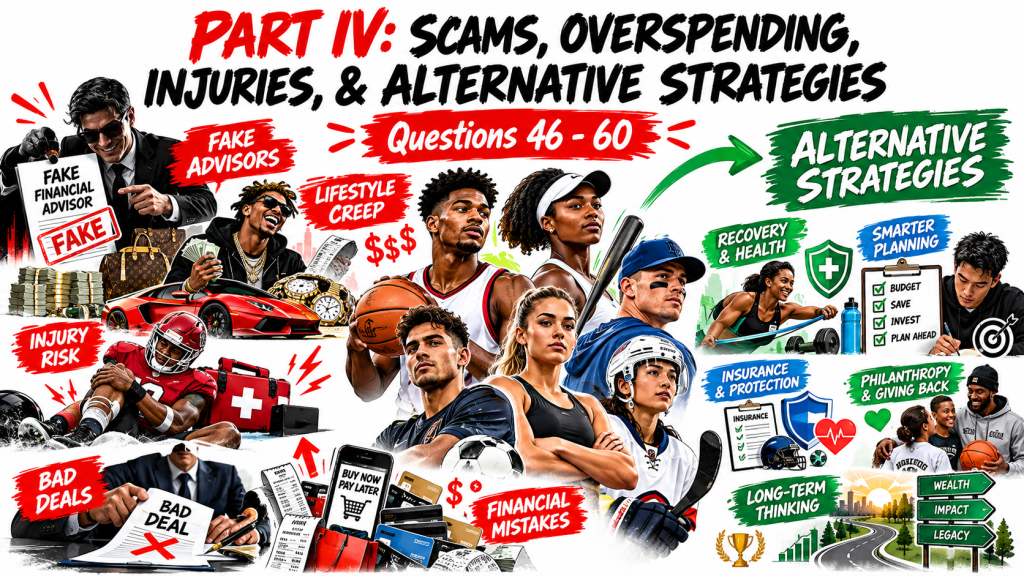
PART IV: SCAMS, OVERSPENDING, INJURIES, & ALTERNATIVE STRATEGIES – Questions 46 – 60
PART IV: SCAMS, OVERSPENDING, INJURIES, & ALTERNATIVE STRATEGIES
46. “What predatory language hides inside standard Morals Clauses?”
Corporate sponsors insert unilateral Morals Clauses allowing them to cancel contracts and terminate payments over public controversy. You must demand Reciprocal Morals Clauses protecting you if the brand faces scandal.
- Unilateral Risk: Brands drop you instantly over minor social media missteps.
- Reciprocal Rights: Gives athletes legal grounds to walk away if corporate sponsors face scandal.
- Cure Periods: Require 30-day written notice and cure periods before contract termination.
47. “How do Exclusivity Clauses silently destroy an athlete’s earning potential?”
Signing an endorsement deal with a broad category definition can legally block you from signing deals with higher-paying non-competing brands. Always narrow exclusivity terms down to specific product lines.
- Category Traps: Don’t agree to “broad apparel” if the sponsor only makes performance shoes.
- Carve-Out Rights: Preserve legal rights to launch personal brand lines in adjacent markets.
- Competitor Definitions: Explicitly name restricted competitor companies in contract exhibits.
48. “Is accepting a sponsorship deal over Instagram DMs or text messages legally binding?”
Yes. DMs and text messages create legally binding contracts without liability protections. Performing commercial work based on informal messages exposes your personal assets to full lawsuit liability.
- Verbal Binding: Messaging threads are legally enforceable in court.
- Zero Liability Shield: Informal deals lack standard corporate indemnification protections.
- Execution Rule: Zero commercial work until a formal written contract is executed by your attorney.
49. “How do I stop companies from using my image ‘in perpetuity’?”
Never sign contract language granting companies rights to your image “in perpetuity throughout the universe.” Set strict term limits (e.g., 1–3 years) with automatic expiration and buy-out multipliers.
- Perpetual Surrender: Grants lifetime commercial rights for a small one-time fee.
- Fixed Terms: Demand mandatory sunset clauses on all promotional image rights.
- Buy-Out Multipliers: Require massive buy-out fees if companies want to extend usage.
50. “What is a ‘Termination for Convenience’ clause and how do I neutralize it?”
Brands insert clauses allowing them to terminate your deal anytime “for convenience” without paying remaining balances. Neutralize this by requiring immediate acceleration of all remaining contract fees upon termination.
- Unilateral Dropping: Brands drop athletes the moment injuries or roster changes occur.
- Accelerated Payouts: Force full payment of contract totals if sponsors terminate early without cause.
- Mutual Rights: Ensure you hold the exact same right to exit bad partnership deals.
51. “How do I audit my agency for hidden fees and clipped commissions?”
Agencies routinely clip hidden marketing commissions or deduct unverified travel expenses. Exercise your contractual Right to Audit to inspect agency financial records with an independent legal team annually.
- Right to Audit: Ensure every agency agreement contains mandatory record inspection rights.
- Commission Caps: Verify agent commissions do not exceed legal limits.
- Kickback Audits: Ensure marketing reps aren’t taking secondary payments from brands.
52. “What specialized insurance policies should high-earning athletes carry?”
Standard health insurance does not protect future contract value. High-earning athletes require specialized Loss of Value (LOV), Permanent Total Disability (PTD), and IP Infringement Insurance.
- PTD Protection: Pays tax-free lump sums if career-ending injuries occur.
- Loss of Value: Covers draft position drops resulting from injuries suffered during play.
- IP Defense: Covers litigation costs when protecting personal trademarks in court.
53. “What happens to active NIL contracts when entering the transfer portal or getting traded?”
Entering the portal or getting traded impacts location-based endorsement contracts. Sponsors write market clauses terminating deals if you change teams, requiring dynamic contract language that survives transfer.
- Market Mobility: Ensure NIL contracts follow you regardless of school or city location.
- Co-Branding Exits: Cleanly resolve university-specific NIL deals upon entering transfer portal.
- Geographic Flexibility: Broaden sponsor terms beyond local market geographic limits.
54. “How do we use hybrid AI tools to audit multi-page agency contracts for predatory traps?”
Legacy law firms charge high hourly fees to review boilerplates, often missing subtle predatory clauses buried on page 40. Custom AI legal engines audit agency contracts instantly, flagging perpetual image grabs and hidden fee splits in seconds.
- Rapid Risk Identification: Instantly flags non-standard, predatory contract terms.
- Fee Split Audits: Detects unauthorized marketing fee deductions automatically.
- Unbiased Analysis: Provides objective second-eye contract evaluations without agency conflicts.
55. “How do forensic accounting audits uncover hidden underpayments in royalty streams?”
Corporate licensees routinely underreport sales figures to reduce royalty checks paid to athletes. Running forensic accounting audits on corporate licensing partners uncovers hidden revenue deductions and unpaid royalties.
- Revenue Verification: Cross-reference reported license sales against audited inventory logs.
- Underpayment Recovery: Force corporate licensees to pay audit costs if underpayments exceed 5%.
- Contract Enforcement: Terminate licensing rights immediately upon uncovering fraudulent reporting.
56. “How do I legally break a predatory early-career contract signed with a handler?”
Young athletes routinely sign predatory contracts with early handlers demanding 20%–33% of lifetime earnings. Terminate these agreements using state talent agency laws, breach of fiduciary duty claims, and unconscionability doctrines.
- Talent Agency Violations: Un-licensed handlers procuring work violate state talent laws.
- Unconscionable Terms: Court doctrines void grossly unfair early-career contracts.
- Fiduciary Breaches: Cancel contracts where advisors placed their financial interests over yours.
57. “Why am I getting state tax audit notices five years after retiring from professional sports?”
Retired athletes routinely receive surprise state tax audit notices years after retirement because their previous CPAs failed to properly clear out multi-state “jock tax” filings. Keep multi-state tax records indefinitely to defend against retroactive assessments.
- Indefinite Audits: Unfiled state tax returns leave audit windows open permanently.
- Record Retention: Archive every multi-state duty day log and tax return permanently.
- Retroactive Fines: States levy heavy interest penalties on un-resolved multi-state taxes.
58. “How does a business partner’s personal default trigger my personal bankruptcy?”
Entering a business joint venture where you sign personal debt guarantees means if your business partner defaults, flees, or commits fraud, the bank comes directly after your personal bank accounts for 100% of the debt balance.
- Joint and Several: You are personally responsible for partner defaults.
- Zero Personal Guarantees: Never execute personal guarantees on corporate debt.
- Entity Insulation: Ensure joint ventures operate as standalone, isolated corporate LLCs.
59. “Why do speculative real estate developments drain an athlete’s liquid cash reserves?”
Athletes are drawn to flashy real estate developments requiring heavy monthly mortgage payments. When vacancies rise or credit markets tighten, these illiquid properties bleed millions in personal cash reserves, forcing emergency liquidations.
- Cash Flow Bleeds: Non-performing properties demand continuous cash capital injections.
- Illiquid Traps: Real estate cannot be sold overnight to satisfy immediate tax bills.
- Over-Leveraging Risks: Taking high-interest bank debt to fund speculative projects leads to default.
60. “How do I turn personal family loans into legally deductible transactions?”
When providing money to friends or family members, never execute informal cash transfers. Structure transfers as formal Promissory Notes with specified interest rates and repayment terms, allowing you to legally write off defaults as business bad debt under IRC Sec. 166.
- Promissory Notes: Formal legal loan documents with clear repayment schedules.
- Bad Debt Write-Offs: Unpaid formal loans can be deducted as business bad debt losses.
- Gift Tax Avoidance: Prevents the IRS from reclassifying loans as taxable personal gifts.
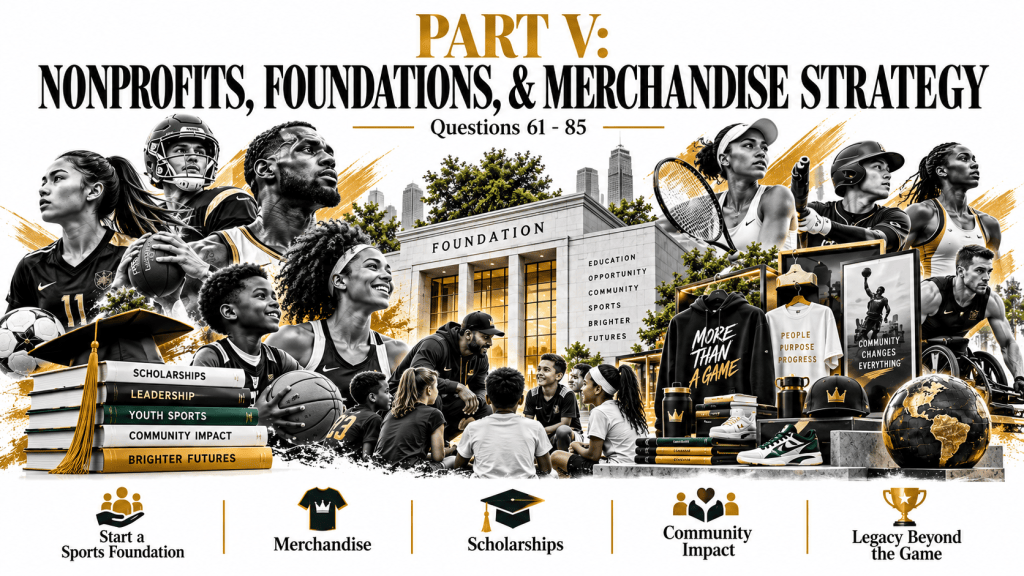
PART V: NONPROFITS, FOUNDATIONS, & MERCHANDISE STRATEGY – Questions 61 – 85
PART V: NONPROFITS, FOUNDATIONS, & MERCHANDISE STRATEGY
61. “What is the real legal difference between a 501(c)(3) Public Charity and a Private Foundation?”
A Public Charity requires at least 33% of its funding to come from the general public and mandates broad board oversight, but it allows donors to deduct up to 60% of their Adjusted Gross Income (AGI). A Private Foundation gives your family total control over the board, but limits cash tax deductions to 30% of AGI under IRC Sec. 170(b)(1)(B) and subjects you to brutal IRS excise taxes on any transaction that looks like self-dealing under IRC Sec. 4941.
- Public Charity: Maximum tax write-offs (60% AGI), but you must constantly prove public fundraising support.
- Private Foundation: Total family governance and privacy, but stricter deduction limits and mandatory 5% annual asset distribution rules.
- The Bottom Line: Most athlete foundations fail within three years because they were misclassified at filing.
62. “Why did the IRS strike down that NIL charity in IRS Letter Ruling 202606003?”
In IRS Letter Ruling 202606003 (as analyzed in the Journal of Accountancy), the IRS explicitly stripped an NIL-focused organization of its tax-exempt status because its primary operational purpose was simply compensating designated student-athletes for their NIL rights under the guise of doing community service. The IRS ruled that directly paying athletes serves private interests under Regs. Sec. 1.501(c)(3)-1(d)(2)—not a public charitable purpose under Sec. 501(c)(3).
- Private Benefit Doctrine: If your foundation’s main pipeline pays money directly to specific athletes, the IRS considers it private enrichment.
- Substantial Non-Exempt Purpose: Paying players for autographs, camps, or social media posts invalidates charitable status.
- The Source: Non-profits must serve the public class, not act as commercial compensation pass-throughs for talent.
63. “Can I get an immediate, massive tax write-off without managing a complex non-profit board?”
Yes—using a Donor-Advised Fund (DAF). Instead of spending tens of thousands in legal fees to set up a foundation, host quarterly board meetings, and file public IRS Form 990s, you drop cash or appreciated assets directly into a DAF. You take an immediate federal tax deduction of up to 60% of your AGI in your highest-earning contract years, and then grant that money out to community causes on your own schedule.
- Immediate Tax Relief: Lock in maximum tax deductions in peak earning years when your tax bracket is highest.
- Zero Administrative Burden: No independent board required, no legal overhead, and no public Form 990 tax returns revealing your personal financials.
- Privacy Shield: Issue grants to local schools or charities completely anonymously if you want to avoid public solicitations.
64. “Is it legal to put my parents, siblings, or friends on my foundation’s payroll?”
Only if you want to trigger federal excise tax penalties that will drain your bank account. Under IRC Sec. 4958, the government enforces strict “Excess Benefit Transaction” rules. If your foundation pays a family member an un-documented salary, an above-market fee, or provides perks without third-party market data, the IRS slaps a 25% penalty on the relative—and escalates it to 200% if not paid back immediately.
- Excess Benefit Taxes: Penalties start at 25% and escalate to 200% if not corrected immediately.
- Market-Rate Audits: All non-profit compensation must be backed by formal third-party salary studies.
- Personal Board Liability: Board members who approve non-arm’s-length family salaries face personal 10% tax penalties.
65. “How do I reroute endorsement money into philanthropy before paying top-bracket income taxes?”
When a corporate sponsor writes a $500,000 endorsement check to you personally, you lose over 50% immediately to federal, state, and jock taxes before you can donate a dime. Executing a Commercial Co-Venturer (CCV) or cause-marketing agreement routes sponsorship funds directly into a verified charitable structure, bypassing your personal income tax bracket.
- Direct Routing: Sponsor capital flows straight into the charitable entity tax-free.
- Zero Phantom Tax: Avoid taking personal taxable income just to donate it back later.
- Corporate Match: Brands get corporate tax write-offs while building your philanthropic legacy.
66. “Can I draw a legitimate management salary from my own non-profit foundation?”
Legally, yes—if you serve as an active Executive Director performing real, documented labor. The pay must strictly reflect fair market value based on independent non-profit compensation benchmarks. If you draw a multi-hundred-thousand-dollar salary while playing 16 games a season and doing zero administrative work, the IRS will classify it as illegal self-dealing under IRC Sec. 4941.
- Reasonable Compensation: Pay must match third-party data for non-profit executives.
- Recusal Rules: You must legally recuse yourself from board votes regarding your own compensation.
- Public Form 990 Exposure: Your salary is published publicly on IRS tax returns every year.
67. “What happens if my foundation sells branded merchandise or charges ticket fees for events?”
You trigger Unrelated Business Income Tax (UBIT) under IRC Sec. 511. When a non-profit regularly carries on a commercial trade or business that isn’t substantially related to its exempt charitable purpose (e.g., selling $100 custom hoodies), those net profits get taxed at standard corporate rates.
- Commercial Activity: Selling physical merchandise triggers standard corporate income tax rates.
- Exempt Purpose Ratio: If commercial sales outweigh real charitable programs, tax-exempt status is revoked.
- Sponsorship Carve-Outs: Structure revenue as qualified corporate sponsorship payments to avoid UBIT.
68. “Are booster-led NIL collectives actually non-profit organizations?”
Listen, the IRS has issued clear guidance warning that booster collectives operating primarily to pay student-athletes do NOT qualify for 501(c)(3) tax-exempt status. Boosters taking tax deductions for collective contributions are facing audit disallowances and back-tax liabilities.
- Revocation Trend: Non-compliant NIL collectives are losing tax exemptions retroactively.
- Donor Liability: Boosters claiming tax deductions for collective payouts face IRS disallowances.
- 1099 Reclassification: Athlete payouts are classified as fully taxable 1099 compensation.
69. “How do I structure a cause-marketing campaign with major corporate sponsors properly?”
Never sign a generic endorsement agreement. You must execute a formal Commercial Co-Venturer Agreement. This contract legally defines the exact percentage of purchase proceeds going to charity, establishes transparent tracking metrics, and satisfies state-level charitable solicitation registration filings across every state where the campaign runs.
- CCV Filings: Most states require legal registration before launching public cause-marketing drives.
- Mandatory Disclosures: Ads must state exact dollar amounts or percentages per item sold.
- Escrow Account Safeguards: Ensure sponsor funds route directly to dedicated charitable escrows.
70. “What exact paperwork do I need to survive an IRS audit of my sports foundation?”
Surviving an audit requires rigid corporate governance: formal Bylaws, signed Conflict of Interest Policies, documented Board Meeting Minutes, compensation studies, and itemized Form 990 schedules.
- Schedule O Realities: Detailed explanations are mandatory for all insider and board transactions.
- Board Independence: Having a board composed entirely of family members triggers instant audits.
- Public Record Scrutiny: Every line item on Form 990 is downloadable by the public via search databases.
71. “How do I scale my local college charity drive into a national pro foundation after the draft?”
Transitioning a local initiative into a national foundation requires expanding your state Charitable Solicitation Registrations across every state where you play games or solicit donations, alongside upgrading board governance.
- Multi-State Filings: Register to solicit charitable donations in every active playing jurisdiction.
- Governance Upgrade: Replace college buddies on the board with independent tax CPAs and attorneys.
- IP Transfers: Transfer charity logos and trademarks into your overarching Holding Company.
72. “Can I turn my sports foundation into my primary career after retiring from sports?”
Absolutely. By building real community programs, securing corporate grants, and maintaining clean governance, you turn your foundation into a self-sustaining enterprise that pays you an executive salary for life.
- Corporate Grant Funding: Transition from funding programs personally to securing corporate grants.
- Executive Role: Transition from active athlete to paid Chief Executive Officer or Chairman.
- Endowment Stability: Build an investment endowment fund that pays out charitable grants perpetually.
73. “What is an ‘Excess Benefit Transaction’ and why should I be terrified of it?”
If your foundation rents office space from a building you personally own, or pays a relative an inflated salary, the IRS slaps strict excise taxes under IRC Sec. 4958 on both you personally and the board managers who approved it.
- First-Tier Penalty: 25% personal tax on the excess benefit amount paid to the insider.
- Second-Tier Penalty: 200% penalty tax if the transaction is not fully corrected immediately.
- Board Member Fines: 10% personal tax on board members who knowingly approved the deal.
74. “What is the ‘Hybrid Model’ combining a For-Profit LLC and a Non-Profit Foundation?”
Never run commercial business and philanthropy out of a single bucket. The elite strategy uses a Holding LLC to own your IP and commercial contracts, which then strategically grants cash or licensing access to your 501(c)(3) Foundation.
- IP Isolation: Commercial trademarks stay protected inside the for-profit Holding LLC.
- Arm’s-Length Grants: The Holding LLC makes tax-deductible contributions to the foundation.
- Clean Audit Boundaries: Keeps commercial business operations separated from public charity filings.
75. “What red flags cause state Attorneys General to audit athlete foundations?”
State AGs enforce charitable trust laws aggressively. Reporting zero charitable program expenses while logging high legal, travel, and vague “consulting” fees will trigger a state subpoena and frozen bank accounts.
- Low Program Ratios: Spending less than 65% of revenue on real charitable programs invites audits.
- Insider Personal Loans: Lending foundation money to board members or family is completely illegal.
- Missing Board Minutes: Failing to record formal board meeting minutes invalidates tax compliance.
76. “How do I sell branded charity merchandise without violating non-profit tax laws?”
To sell merchandise tax-free through a non-profit, the merchandise sales must be directly substantially related to your exempt purpose, or operated entirely by volunteers. Otherwise, run sales through your Holding LLC and donate net profits.
- Substantial Relationship Test: Merchandise must directly further charitable education or awareness.
- Volunteer Exception: Merchandise sales operated 85%+ by uncompensated volunteers bypass UBIT.
- For-Profit Routing: Sell gear through your for-profit LLC and make clean charitable grants to the non-profit.
77. “How do I protect my personal trademarks when licensing them to my own charity?”
Never gift your personal trademarks permanently to your non-profit. Execute a revocable, non-exclusive IP License Agreement from your Holding LLC to the non-profit for $1 per year, retaining 100% underlying trademark ownership.
- Revocable Licenses: Maintain the legal right to revoke trademark usage if the non-profit dissolves.
- Zero Capital Transfer: Retain trademark asset value inside your for-profit holding structure.
- Quality Control Clauses: Retain legal oversight over how your logo is printed on charity gear.
78. “What are the tax implications of donating auction items versus cash to a foundation?”
Donating physical property or memorabilia to your non-profit triggers strict valuation rules under IRC Sec. 170. Donating your own autographed items only allows deducting the cost of materials (the $15 blank football), not fair market value.
- Cost Basis Rule: Autographed personal gear write-offs are limited to blank product purchase costs.
- Qualified Appraisals: Donating third-party property valued over $5,000 requires formal CPA appraisals.
- Form 8283 Filings: File Form 8283 for all non-cash charitable property contributions exceeding $500.
79. “How do I structure corporate gala sponsorships so the revenue remains tax-free?”
Structure corporate sponsor payments for charity galas as “qualified corporate sponsorship payments” under IRC Sec. 513(i). Avoid providing promotional advertising or endorsement statements; provide simple corporate logo recognition.
- Use vs. Acknowledgment: Displaying corporate logos is tax-free recognition; promoting products is taxable advertising.
- No Exclusivity Inducements: Avoid offering exclusive commercial sales rights to gala sponsors.
- Clean Written Receipts: Issue formal contemporaneous written acknowledgments detailing sponsorship terms.
80. “What happens to non-profit foundation assets if I dissolve the organization?”
Assets held by a 501(c)(3) organization are permanently dedicated to the public. If you dissolve your foundation, state law and IRS rules mandate that remaining assets must be transferred to another tax-exempt 501(c)(3) entity.
- Nondivertibility Rule: Foundation assets can never be returned to the founder or family members.
- Dissolution Clauses: Articles of Incorporation must contain explicit charitable dissolution language.
- State AG Oversight: State Attorneys General must review and approve final asset distribution plans.
81. “How do I set up a sports foundation board that maintains public compliance?”
A compliant board requires a majority of independent, non-family members. Having a board composed entirely of parents and siblings destroys credibility during IRS reviews and AG audits.
- Independent Majority: Maintain a board with majority independent legal, tax, and community leaders.
- Quorum Rules: Establish clear voting quorums that prevent family self-dealing votes.
- Annual Conflict Disclosures: Require every board member to sign annual conflict-of-interest forms.
82. “How can a sports foundation legally fund youth athletic scholarships?”
To fund youth scholarships tax-free, your foundation must establish objective, non-discriminatory criteria approved by the board. Scholarships cannot be restricted to relatives, friends, or specific business partners.
- Objective Criteria: Base awards on academic merit, demonstrated financial need, or community service.
- IRS Approval: Private foundations must obtain advance IRS approval under IRC Sec. 4945(g) for scholarship programs.
- Direct School Payments: Route scholarship funds directly to educational institutions, not individuals.
83. “What is the difference between a foundation grant and a business contract?”
A charitable grant is an unconditional transfer of funds to further an exempt purpose without commercial return. A contract is a payment for specific commercial services, triggering taxable income and potential UBIT.
- Unconditional Transfer: Grants must not mandate commercial promotional returns for the donor.
- Reporting Obligations: Grant recipients must submit formal program expenditure reports.
- Contract Reclassification: Contracts disguised as grants will be reclassified during tax audits.
84. “How do I prevent embezzlement and internal theft inside my foundation?”
Athlete foundations are prime targets for internal fraud by un-audited directors. Implement strict dual-authorization bank controls, mandate two signatures on checks over $2,500, and conduct annual independent audits.
- Dual Authorization: Require two independent board signers on all bank transfers and checks.
- Third-Party CPA Audits: Hire an independent CPA firm to audit foundation books annually.
- Segregation of Duties: Separate the person who approves expenses from the person issuing payments.
85. “How do I use a sports foundation to build multi-generational family legacy?”
A properly structured sports foundation provides a permanent platform for your family to drive community impact, manage philanthropic programs, and build generational reputation long after your playing days end (similar to public-private hybrid models like the LeBron James Family Foundation).
- Perpetual Mission: Create an institutional legacy that operates independent of athletic playing status.
- Next-Gen Involvement: Involve children in formal, compliant charitable governance roles as adults.
- Endowment Longevity: Invest foundation assets conservatively to generate perpetual grantmaking capital.

PART VI: LIFETIME EXECUTION BLUEPRINT – Questions 86 – 101
PART VI: LIFETIME EXECUTION BLUEPRINT
86. “High School Stars: How do I monetize NIL without destroying college eligibility?”
High school athletes must navigate a messy patchwork of state athletic association rules regarding NIL monetization. A single wrong endorsement move before high school graduation can permanently destroy college athletic eligibility.
- State Patchwork: NIL rules vary completely across different state high school associations.
- Zero School Marks: Never wear high school team uniforms in commercial promotional posts.
- Pre-College Entities: Establish legal business entities early to receive compliant NIL earnings.
87. “Collegiate Athletes: How does House v. NCAA revenue-sharing impact my independent NIL deals?”
The House v. NCAA settlement creates direct revenue-sharing models where universities pay athletes directly. This university income is fully taxable W-2/1099 compensation that must be balanced alongside independent third-party NIL endorsement deals.
- Dual Income Streams: Manage direct university payouts alongside private commercial NIL deals.
- Institutional Contracts: Review revenue-sharing terms with independent legal counsel.
- Tax Withholding Realities: Plan for state tax filings across university payout channels.
88. “Draft Prospects: How do I transition my college NIL LLC into a professional Family Office?”
During draft preparation, your college NIL LLC requires a total corporate upgrade. Merge early NIL structures into a centralized Family Office Architecture capable of managing multi-million-dollar playing contracts, multi-state taxes, and global endorsement portfolios.
- Corporate Restructuring: Upgrade simple college LLCs into multi-tiered Holding Companies.
- Multi-State Tax Prep: Prepare for immediate multi-state jock tax filings upon entering the pros.
- Professional Governance: Replace early student advisors with credentialed tax attorneys and CPAs.
89. “Pro Athletes: How do I demand startup stock equity instead of cash endorsement fees?”
Pro athletes during peak earning years should use endorsement leverage to demand equity and stock ownership in startup companies rather than relying solely on short-term cash payments. Building equity portfolios creates multi-generational wealth that outlasts playing careers.
- Equity Carve-Outs: Require startup sponsors to include vested equity shares in deal structures.
- Board Observer Rights: Secure board observer seats to monitor company growth operations.
- Long-Term Capital Gains: Taxed at lower capital gains rates upon successful startup exits.
90. “Pro Athletes: How do I manage lifestyle burn rates during peak earning years?”
Peak earning years pass quickly; managing lifestyle burn rates and personal overhead costs is critical to long-term survival. Establish strict personal budget caps, route all contract money into trust architectures first, and pay yourself a fixed monthly salary.
- Fixed Living Budgets: Cap personal living expenses at a fraction of net income.
- Automated Savings: Direct 60%+ of net cash into tax-advantaged investment trusts.
- Overhead Monitoring: Track monthly family and business overhead expenses ruthlessly.
91. “Retired Athletes: How do I convert my athletic legacy into perpetual royalty streams?”
Upon retiring, your active athletic salary drops to zero, but your intellectual property can generate continuous royalty streams. License your legacy image, historic highlights, and personal trademarks for documentaries, apparel, retro video games, and corporate speaking.
- Perpetual Royalty Streams: License legacy image rights to media networks and game developers.
- Documentary Monetization: Executive produce and retain equity ownership in career retrospective media.
- Retro Merchandise: Launch retro apparel lines leveraging fully owned registered trademarks.
92. “Retired Athletes: How do I enforce my player union pension and health trust benefits?”
Navigating professional player union (NFLPA, NBPA, MLBPA) pension structures, health trusts, and disability benefits requires active legal enforcement. Ensure you claim all post-career medical and financial benefits owed under collective bargaining agreements.
- Pension Optimizations: Structure union pension distributions to minimize taxable hits.
- Health Trust Claims: Maximize reimbursement claims from union health management trusts.
- Disability Benefit Audits: File formal claims for union disability and line-of-duty benefits.
93. “Female Athletes: How do I build direct-to-consumer digital media platforms?”
Elite female athletes are outperforming traditional sports markets by taking direct ownership of digital media channels, building direct-to-consumer businesses, and executing structured equity endorsements that build massive commercial value.
- Owned Digital Channels: Monetize direct-to-consumer platforms bypassing traditional media gatekeepers.
- Equity Dominance: Leverage high engagement rates to demand higher startup equity stakes.
- Global Sponsorships: Structure international brand deals protected by robust IP licensing.
94. “Combat & Individual Sports: How do I deduct high coaching, travel, and training overhead?”
Individual-sport athletes (MMA, Boxing, Golf, Tennis) operate as independent business enterprises responsible for 100% of their own coaching, travel, medical, and camp overhead. Use corporate entity structures to deduct these massive overhead costs legally under IRC Sec. 162.
- Business Deduction Management: Deduct all training camp, coaching, travel, and medical overhead.
- Global IP Protection: Protect personal trademarks across global international jurisdictions.
- High-Risk Medical Shields: Maintain specialized disability and medical injury insurance policies.
95. “Athlete Parents: How do I protect my child star’s wealth while allowing them independence?”
Parents of young athletic phenoms must build legal frameworks that preserve their child’s accumulated wealth while establishing clear legal boundaries that protect the child from financial exploitation by outside handlers or family members.
- Child Trust Protections: Route minor athlete earnings into protected legal trust structures.
- Independent Guardianship: Ensure legal contracts preserve child capital for adulthood.
- Compliant Family Payroll: Pay parents fair market rates for real managerial duties performed.
96. “What legal errors cause estates of famous icons to face decades of public litigation?”
Passing away or retiring without strict, immutable IP trusts and non-probate legacy structures leads to decades of public court litigation, massive probate fees, and federal tax liens that force the fire-sale of prized IP assets.
- Probate Exposure: Dying without trusts makes entire financial portfolios public court record.
- Tax Liquidation: Forced sales of legacy IP to pay 40% federal estate taxes within 9 months.
- Family Destruction: Relatives spend millions in legal fees fighting over un-assigned assets.
97. “How do Federal Estate Taxes wipe out illiquid family real estate and business holdings?”
Federal estate taxes hit 40% on assets transferred above federal exemption limits. If your estate consists of illiquid assets (real estate, private business equity, future IP royalties), your heirs will be forced to sell assets at fire-sale prices just to pay the IRS bill within 9 months.
- 40% Tax Rate: Massive federal tax hit on multi-generational wealth transfers.
- Illiquidity Crisis: Estates have 9 months to pay federal estate taxes in liquid cash.
- ILIT Solutions: Use Irrevocable Life Insurance Trusts to provide liquidity for tax bills.
98. “How do I legally structure loans given to friends and family so they are enforceable?”
When providing money to friends or family members, never execute informal cash transfers. Structure transfers as formal Promissory Notes with specified interest rates and repayment terms, allowing you to legally write off defaults as business bad debt.
- Promissory Notes: Formal legal loan documents with clear repayment schedules.
- Bad Debt Write-Offs: Unpaid formal loans can be deducted as business bad debt losses.
- Gift Tax Avoidance: Prevents the IRS from reclassifying loans as taxable personal gifts.
99. “How do I insulate my accumulated athletic wealth from high-stakes civil litigation?”
Being a high-profile athlete makes you a primary target for frivolous civil litigation following minor incidents or accidents. Maintain multi-million-dollar Personal Umbrella Insurance Policies stacked on top of your trust structures to absorb litigation claims.
- Umbrella Policies: Secure $10M–$25M umbrella insurance coverage limits.
- Litigation Defense: Insurance carriers pay full legal defense costs during civil claims.
- Asset Protection Layer: Shields primary trust capital from civil judgment payouts.
100. “What historical IRS court rulings serve as warning signs for athlete tax write-offs?”
Decades of IRS tax court rulings establish that claiming personal living expenses as business deductions leads directly to civil tax fraud penalties (75% under IRC Sec. 6663) and criminal indictments. Understand tax court precedents before attempting “creative” tax deductions.
- Tax Court Record: IRS systematically wins against un-documented athlete expense claims.
- Fraud Penalties: 75% civil tax fraud penalties added to unpaid tax balances.
- Strict Liability: Ignorance of tax law is never a valid defense in tax court.
101. “The Ultimate Master Plan: How do I integrate BENT Law, tax redirection, trusts, and AI?”
True success means integrating BENT Law (Business, Estate, Nonprofit, Tax), tax redirection, asset protection trusts, non-profit foundations, and hybrid AI tools into a single Family Office Architecture. Control your brand, minimize your taxes, protect your capital, and build a legacy that lasts forever.
- Total Asset Control: Protect every dollar earned through unified legal and tax architecture.
- Tax Elimination: Redirect taxes into family trusts, foundations, and wealth engines.
- Unbiased Fiduciary Governance: Partner with independent advisors who protect your interests above all else.

